 MapleSpeak
The eight tasks at a glance
Preparation time comes first, then the recording starts on its own. You can’t pause or go back. Timings below are prepare, then speak.
| Task | Name | Timing | What it tests |
|---|---|---|---|
| 1 | Giving Advice | 30 s + 90 s | Clear suggestions with reasons |
| 2 | Talking about a Personal Experience | 30 s + 60 s | Telling a story in the past |
| 3 | Describing a Scene | 30 s + 60 s | Describing what you see |
| 4 | Making Predictions | 30 s + 60 s | Talking about the future |
| 5 | Comparing and Persuading | 60 s choose + 60 s + 60 s | Comparing and convincing |
| 6 | Dealing with a Difficult Situation | 60 s + 60 s | Polite, tactful problem-solving |
| 7 | Expressing Opinions | 30 s + 90 s | Arguing a point of view |
| 8 | Describing an Unusual Situation | 30 s + 60 s | Describing an object in detail |
Altogether that is 900 seconds, exactly 15 minutes. Tasks 3 and 4 use the same picture.
What raters listen for
Every answer is judged on four criteria. Knowing them tells you what a “good” answer is.
- Content and coherence: enough relevant ideas, in a clear order, linked together.
- Vocabulary: the right words for the topic, used precisely, with some range.
- Listenability: a steady pace, clear pronunciation, few long pauses and fillers.
- Task fulfillment: doing exactly what the task asks, for the listener it names, until the time ends.
The sample answers below were written for this guide in the style of the test. They are not official CELPIP material. Read each one out loud with a timer: if you finish early, your own answers probably need one more idea.
Task 1: Giving Advice
Help someone with a problem
30 s prepare · 90 s speakYour friend Daniel has just moved to a new city for work. He feels lonely and does not know anyone yet. Give Daniel some advice on how to meet new people.
Hi Daniel, I know moving to a new city can feel lonely at first, so here are a few ideas. First, join a club or a sports team. If you like running, most cities have free running groups on weekends, and you meet people naturally while doing something you enjoy. Second, say yes to invitations from your coworkers, even small ones like a coffee after work. Those moments build real friendships. Finally, try volunteering. It gives you a routine, and you meet kind people who care about the community. Give it a few weeks, and I am sure you will feel at home.
Why it works: it speaks to Daniel by name, gives three ideas in order (first, second, finally), adds a reason or example to each, and ends with encouragement. For 90 seconds, add one more detail to each idea.
Task 2: Talking about a Personal Experience
Tell one real story
30 s prepare · 60 s speakTalk about a time when you made a mistake at work or at school. What happened, and what did you learn from it?
A few years ago, I was working in a hotel, and I booked two families into the same room by mistake. When the second family arrived late at night, the room was already taken. I felt terrible. I apologised right away, found them a bigger room at the same price, and gave them free breakfast. In the end, they were happy and even left a good review. That experience taught me to always double-check my work, especially when I’m busy, and also that being honest quickly is the best way to fix a mistake.
Why it works: one story, told in the past tense from start to finish. It sets the scene in one sentence, says how the speaker felt, and ends with what they learned, which answers both parts of the question.
Task 3: Describing a Scene
Describe a picture to someone who can’t see it
30 s prepare · 60 s speak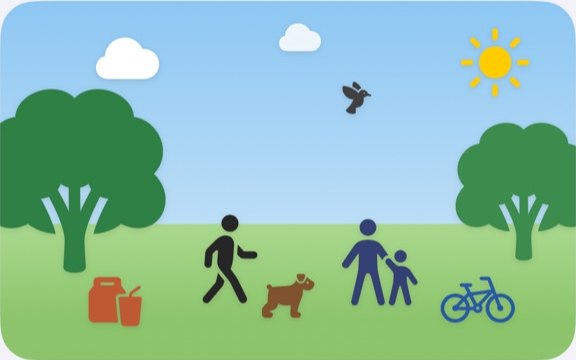
Describe some things that are happening in the picture as well as you can. The person you are speaking to cannot see the picture.
This picture shows a sunny afternoon in a city park. On the left, there is a large green tree, and under it someone has left a picnic bag and a drink on the grass. In the middle, a man is walking his small brown dog along the path. Next to them, a parent and a child are holding hands and walking to the right. On the far right, a blue bicycle is parked next to another tree. The sky is bright blue with a few white clouds, the sun is shining in the top right corner, and a bird is flying above the trees. It looks like a relaxing day.
Why it works: it moves through the picture from left to right, says where each thing is, uses the present continuous for actions (is walking, is shining), and adds colours and sizes so the listener can imagine it.
Task 4: Making Predictions
Say what will happen next in the same picture
30 s prepare · 60 s speakIn this picture, what do you think will most probably happen next?
I think the dog will soon smell the picnic bag under the tree and pull its owner toward it, because dogs love food. The man will probably laugh and call the dog back. The parent and child are going to reach the playground, and the child will run straight to the swings. The owner of the bicycle might come back from a walk and ride home before evening. Since it is such a warm day, more people will arrive in the park later, and the area around the trees is going to get busier.
Why it works: every sentence is about the future (will, is going to, might), and every prediction comes from something in the picture. Describing the picture again is the most common mistake in this task.
Task 5: Comparing and Persuading
Choose an option, then defend it
60 s choose · 60 s prepare · 60 s speakThis task has two parts. First you get 60 seconds to choose between two options, with no speaking. Then a family member or friend suggests a third option, and you have 60 seconds to prepare and 60 seconds to persuade them that your choice is better.
Your family is planning a three-day weekend trip. You chose the cabin by the lake ($450 for 3 nights, a 2-hour drive, canoeing and hiking). Your brother would rather go to a beach resort ($1,100 for 3 nights, a 4-hour flight, pool and spa). Persuade him that your choice is better.
I understand the beach resort sounds amazing, but I really think the cabin by the lake is the better choice for this weekend. First, it’s much cheaper. The resort costs eleven hundred dollars, and the cabin is only four hundred and fifty, so we’d save more than six hundred dollars. Second, we only have three days, and a four-hour flight plus airport time would take most of a day. The cabin is a two-hour drive. And we can still swim and relax at the lake, with canoeing and hiking right outside the door. Let’s keep the resort for a longer vacation.
Why it works: it names the preferred option in the first sentence, admits the other option’s appeal, then compares the two on cost and time with real numbers from the task. Comparing both options, not just praising yours, is what “persuading” means here.
Task 6: Dealing with a Difficult Situation
Solve a delicate problem politely
60 s prepare · 60 s speakYou promised to cover a coworker’s shift this Saturday, but your sister has just told you her wedding rehearsal is the same day. Choose one person to talk to, and explain the situation.
Hi Jordan, I’m really sorry, but I have a problem with Saturday. I promised to cover your shift, and I know you have your family trip planned. My sister just told me her wedding rehearsal is on Saturday afternoon, and I have to give a speech. I don’t want to leave you without help, so I already asked Mei, and she can work from morning until two. I can come in at six and finish the shift. Would that work for you? I’m very sorry for the trouble, and I’ll be happy to cover for you another time.
Why it works: it starts with an apology, explains the problem honestly, shows it understands the other person’s side, and offers a concrete solution before asking a question. The tone is what raters notice most in this task.
Task 7: Expressing Opinions
Take a side and support it
30 s prepare · 90 s speakSome people believe a four-day work week would be better for both workers and businesses. Do you agree or disagree? Explain why.
I agree that a four-day work week would be better for most workers and businesses. First, people who rest more are happier and healthier, so they take fewer sick days. Second, when employees know they have only four days, they often work more efficiently and waste less time in long meetings. Some companies that tried it said productivity stayed the same or even improved. Third, it would help companies attract and keep good employees. Of course, it doesn’t work for every job, like hospitals or stores, but those businesses could use flexible schedules instead.
Why it works: the opinion comes in the first sentence, three reasons follow in order, and it answers the obvious objection before finishing. With 90 seconds, add an example to each reason and repeat your position at the end.
Task 8: Describing an Unusual Situation
Describe a strange object on the phone
30 s prepare · 60 s speakYou are shopping for your friend’s birthday gift and you see an unusual item: a bicycle with an umbrella above the seat. Call your friend’s partner and describe the item in detail. They cannot see it.
Hi Lisa, I just found the most unusual gift for Tom. It is a bicycle, but it has a large orange umbrella attached above the seat, like a small roof, so you can ride in the rain without getting wet. The frame is light blue, and there is a basket at the front full of small green plants, which is just decoration. The umbrella can fold down when the weather is nice. It costs a bit more than we planned, but since Tom rides to work every day, I think he would love it. What do you think?
Why it works: it speaks to the person on the phone, compares the object with something familiar (like a small roof), describes colour, size and how it works, and gives a reason it suits Tom.
Five mistakes that cost a level
- Stopping early. Silence at the end usually means fewer ideas and less vocabulary on the recording.
- Answering a different question. Describing in task 4, or giving your opinion in task 6, misses task fulfillment.
- Forgetting the listener. Tasks 1, 6 and 8 name a person. Speak to them by name, in a tone that fits.
- Reading a memorised script. It sounds flat and rarely fits the exact question.
- Using preparation time to write sentences. Write three key words, not a paragraph.
How to practise in two weeks
- Days 1 to 3: answer each task once on the real timer, record yourself and note where you stopped early.
- Days 4 to 7: repeat your two weakest tasks every day with a new question each time.
- Days 8 to 10: read the sample answers out loud, then answer the same questions without looking.
- Days 11 to 14: do two full eight-task runs, back to back, as on test day.
Want to know what each level means for immigration? See the CELPIP score chart.
Sources
Task names, order and timings: CELPIP-General test format on celpip.ca and Paragon’s 2026 Speaking study packs. Rating criteria: CELPIP-General overview, celpip.ca. Checked October 7, 2026.
Questions
How long is the CELPIP speaking test?
Exactly 15 minutes of preparation and speaking time across eight tasks. Task 5 is the longest, at three minutes, because you first choose between two options.
How many words should a CELPIP speaking answer be?
There is no word count, but a calm, complete answer is usually about 120 to 140 words in 60 seconds and 180 to 220 words in 90 seconds. Speaking until the timer ends matters more than speed.
Can I memorise CELPIP speaking answers?
Memorised answers rarely fit the exact question, and raters mark task fulfillment. Memorise useful sentence starters and structures instead, then fill them with the details of the question in front of you.
What happens if I stop speaking before the time ends?
Nothing is lost by the silence itself, but a short answer usually covers less of the task and shows less vocabulary, so it tends to score lower. Plan two or three ideas so you have enough to say.